
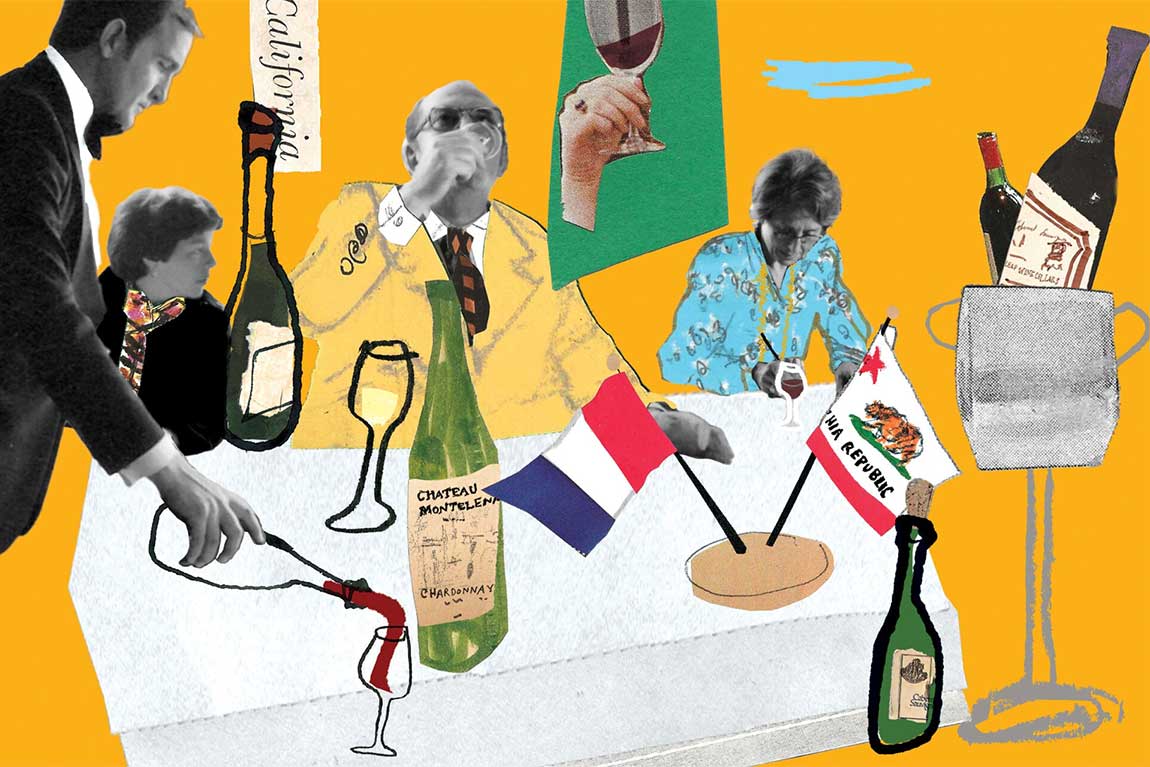
Five decades after the blind tasting that shook the world, the California wines that bested Burgundies and Bordeaux are in the limelight once again.
It’s been 50 years since a blind tasting in Paris turned the wine world upside down. Back then, in 1976, French wine was king; France’s wine regions set the standard for the rest of the world. In California, serious winemaking was just getting started. As the US prepared to celebrate its bicentennial that summer, Steven Spurrier, a British expat with a small wine school in Paris, L’Académie du Vin, and an adjacent wine shop, Les Caves de la Madeleine, devised a marketing scheme to mark the milestone—a deliberately provocative tasting, pitting upstart California wineries against top French producers.
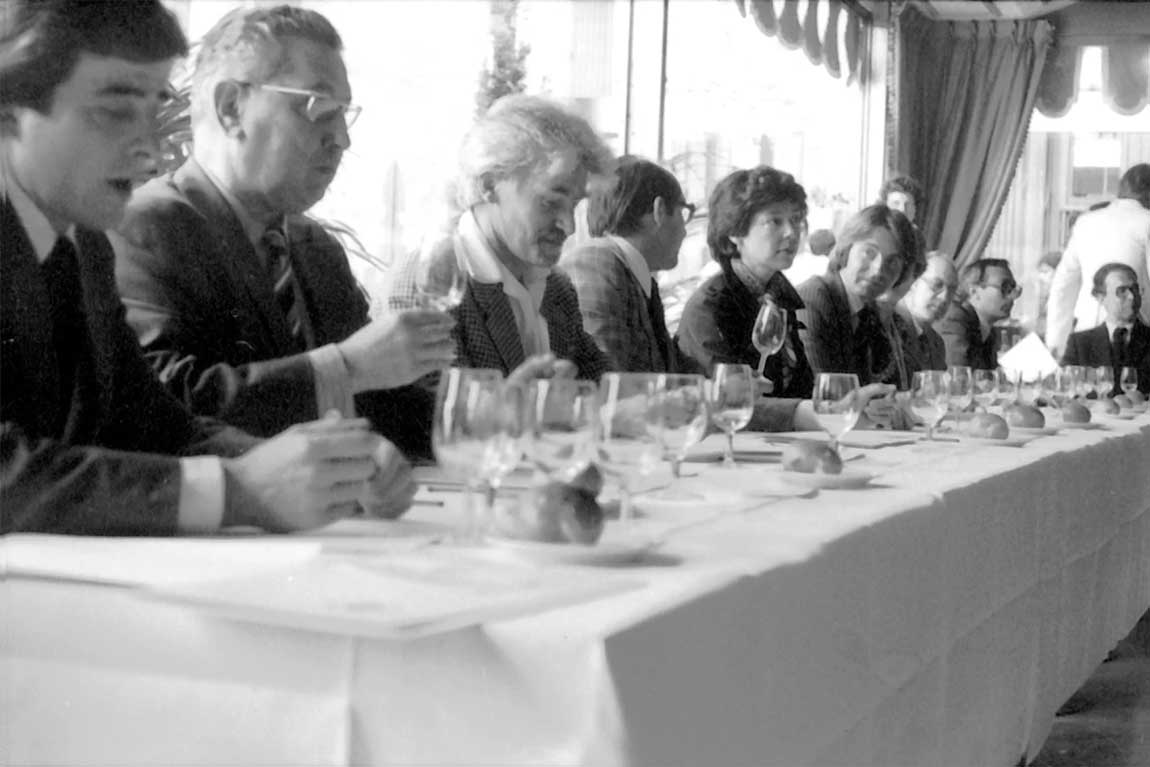
On the afternoon of May 24, 1976, Spurrier gathered a panel of nine French judges—wine critics, sommeliers and restaurant professionals—at the Intercontinental Hotel in Paris. After a visit to California wine country, Spurrier had selected six chardonnays and six cabernet sauvignons from Napa and Sonoma; he chose an equal number of Bordeaux reds and Burgundy whites. All were decanted to obscure their identities.
Seated at a long table, with spectators on a balcony above, the judges sipped, swirled, and spat, expecting an easy French rout. The event might have garnered little attention beyond Parisian wine circles if an American writer, George Taber, hadn’t been in the audience—the only journalist present—as the Californians proceeded to annihilate the French.
When the scores were tallied, a chardonnay from Chateau Montelena, in Calistoga, California, had beaten a Meursault Charmes from Burgundy to take the top spot among the whites. A cabernet sauvignon from Napa’s Stag’s Leap Wine Cellars had come in first among the reds, with a Château Mouton Rothschild behind it.
The California winemakers learned of their underdog victories two weeks later, when Time magazine published a small article by Taber under the headline “Judgement of Paris,” extolling the moment “the unthinkable happened: California defeated all Gaul.”
Taber’s four-paragraph story was later picked up by the French press and ricocheted around the world. The Judgement of Paris, as the tasting became known, turned into a cultural touchstone, a catalyst ushering in a golden age for New World wines. “The tasting,” says Jonathan Lai, a voracious collector whose cellar ranges from Bordeaux to Napa to the Andean foothills in Chile, “paved the way for New World wines in general to compete at the highest level.”
“It was a historic moment in time—the French were resting on their laurels, not paying much attention to wines of other regions,” says Nick Pegna, Global Head of Wine & Spirits at Sotheby’s. “This was a wake-up call.”
At Chateau Montelena, winemaker Mike Grgich’s winning 1973 white was only the second chardonnay vintage the winery had ever released. “My father at first couldn’t believe it,” says Violet Grgich of his victory. She was just 10 years old at the time. “They were still trying to figure things out,” says Matthew Crafton, president of Chateau Montelena. “This was a story of unexpected greatness. And I think it shaped our culture and our decision-making and how we look at the world, even though it was 50 years ago.”
Both the winning red and white wines are now in the permanent collection of the Smithsonian’s National Museum of American History in Washington, displayed alongside Julia Child’s TV kitchen. They’re highly prized as collectibles and increasingly scarce.
You might expect a few more bottles than usual of those wines to emerge from cellars this year. “I think people who have these bottles, who have been sitting on them and who are thinking of selling, this would be the moment to do it,” says Pegna.
Of the 14 remaining bottles of ’73 chardonnay still in the cellars at Chateau Montelena, one entered the market at the start of the year as part of the $200,000 Judgement of Paris package—which included a private winery tour, vertical tasting and dinner—sold by the winery in partnership with Robb Report magazine.
“It was a historic moment in time—the French were resting on their laurels, not paying much attention to wines of other regions. This was a wake-up call.”
Stag’s Leap Wine Cellars has a deeper reserve of its winning red, the ’73 Stag’s Leap Vineyard Cabernet Sauvignon. “We probably have about 40 bottles left,” says the current head Winemaker, Marcus Notaro. He hopes to open a few at dinners he’ll host at top restaurants around the US this year, to mark the anniversary of the Paris rout. “I have had the honor of tasting that wine several times through the years,” says Notaro, who started at the winery in 2013. “It’s fun, especially aromatically. It still has some liveliness to it, some of the black currants and violets and tobacco notes.”
Both winning wineries are releasing special Judgement of Paris bottlings this year. Chateau Montelena has sourced grapes from the same vineyards as the 1973 chardonnay for a sparkling wine, brandy and 50th-anniversary chardonnay. Stag’s Leap’s commemorative bottle, of 2023 Stag’s Leap Vineyard Cabernet Sauvignon, will come in magnum only, in a limited run of 1,973 bottles, produced from old vines planted in 1972. “Although the wine isn’t from the time of the tasting, the 1970s, it’s from vines of that era,” says Notaro.
Violet Grgich, who today runs Grgich Hills Estate, the winery founded by her late father after he left Chateau Montelena, is also releasing a 50th-anniversary bottle, a new edition of the Paris Tasting Commemorative Chardonnay first introduced on her father’s 90th birthday in 2010. “For us it was always about celebrating the fact that America, and Napa Valley in particular, was able to make wine of the highest quality,” she says, “not necessarily that we beat the French.”
Taber, eventually, expanded his small article into a 312-page nonfiction book, a deep dive into the birth of the California wine scene, culminating in the showdown in Paris, first published in 2005. The book helped inspire a Hollywood film, “Bottle Shock,” a light comedy released in 2008, starring Alan Rickman as Spurrier and Chris Pine as a young Bo Barrett, a rebellious “cellar rat,” as he’s portrayed onscreen, whose father ran Chateau Montelena in 1976. (Today Bo Barrett is the winery’s CEO.)
This summer, those and other key figures from the ’76 tasting will appear as characters in a comedic opera, from composer Jake Heggie, premiering in July at Festival Napa Valley. “Truly great ideas for comic operas are very hard to come by,” says Heggie, “but this story just spoke to me immediately.”
“For us it was always about celebrating the fact that America, and Napa Valley in particular, was able to make wine of the highest quality, not necessarily that we beat the French.”
The production, staged at the Charles Krug winery in St. Helena, will include Greek and Roman gods, along with singing winemakers. “The opera has a very strong mythological component,” says Charles Letourneau, Vice President and Director of Artistic Planning of Festival Napa Valley. “There’s a role for Zeus and a role for Venus. Here in Napa, we feel in a way that the gods intervened in our favor.”
There will be plenty of dinners and tastings honoring the Judgement of Paris in California wine country, and across the US, this year. (An amateur enthusiast has created a website, judgementofparis50.com, as a central clearinghouse for commemorative events.) The biggest celebrations, though, won’t arrive until the fall, when Stag’s Leap will host a big party, inviting winemakers from around the world who, early in their careers, spent time working in their vineyards and cellars. “After the Paris tasting, a lot of people wanted to work here, to see what the magic was about,” says Notaro. “And a lot of them went on to make big names for themselves.”
The most ambitious event might be the Judgement of Napa, which wine concierge Angela Duerr, of Cultured Vine in Napa, is planning for fall. This blind tasting, with spectators and a seated banquet (tickets start at $2,000), will pit recent vintages of California cabernet sauvignon and chardonnay against wines from around the world. “We’ve chosen Italian, French, Chilean, Australian, whatever works that’s on par, that can compete,” says Duerr.
With the passing, in recent years, of so many key figures of the Judgement of Paris—Spurrier died in 2021, Mike Grgich in 2023 and Stag’s Leap founder Warren Winiarski last year—the Paris tasting has begun to fade into history. Increasingly, visitors to Chateau Montelena haven’t heard the story before. “We have to reintroduce the story constantly,” says Crafton. “The more people learn about it, the more they realize it’s recent history, in the grand scheme of things. It’s a story they can believe in. They not only fall in love with the story, but also fall in love with wine in general.”
POSTED WITH PERMISSION. COPYRIGHT SOTHEBY’S. Click to read original article.